All Subaru vehicles feature a symmetrical all-wheel drive (AWD) system. This places the engine in-line with the drivetrain, allowing it to distribute traction throughout all four wheels in different road conditions and maintain stability. It also helps make those tight hairpin curves, like the so-called "Dead Man's Curve" along Hickory Drive in Bossier Parish.
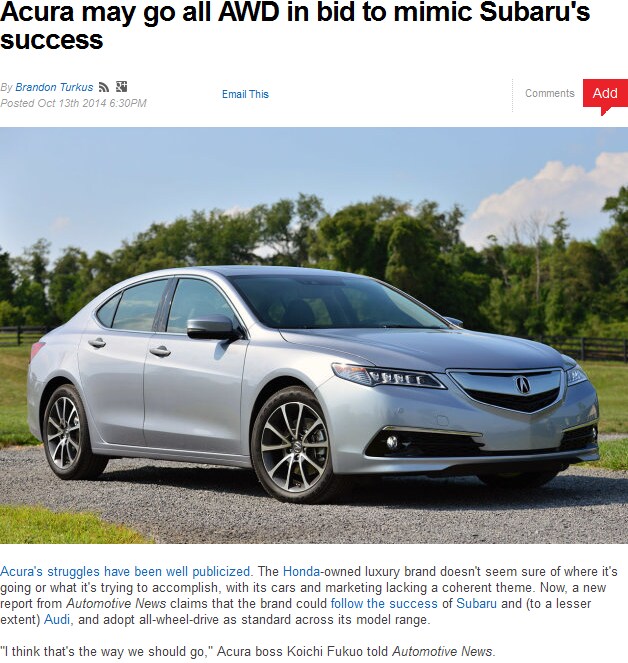
In fact, Subaru has been so successful with its AWD that other manufacturers are considering emulating it. Acura, for one, has experts looking to a prospective future.
"Subaru has carved out a niche with this and has cultivated one of the most loyal bases in the industry," Edmunds Jeremy Acevedo told Automotive News. "The AWD direction Fukuo aims to take Acura in also shows considerable promise."
"Making Acura 100-percent all-wheel drive could be a good idea," Tatsuo Yoshida, of Barclays Securities Japan, told AN. "It is very simple from a sales and marketing point of view to sell the cars with such technology."
For the record, AWD isn't the same as four-wheel drive (4WD). A 4WD system is often designed for off-road vehicles, applying maximum torque to all wheels to help the vehicle get over huge obstacles easily. An AWD system, meanwhile, is designed for reducing slippage in wet roads or when making tight turns by applying maximum traction. 4WD is torque; AWD is traction.
As AWD is relatively new in the car industry, most manufacturers haven't implemented it as a standard feature. Subaru is one of a few, if any, that broke ground by offering their AWD system to every new model available in Covington, LA car dealerships. However, every model harnesses its own AWD system differently.
The most common among Subaru's lines is viscous coupling, considered by many tech experts as the workhorse of the brand's AWD system. This function provides a 50-50 torque split under normal conditions and 80-20 wherever the system detects slippage. The oldest AWD system in Subaru's inventory attests its reliability by being included in the new 2015 WRX.
In automatic transmissions, Subaru's AWD uses variable torque distribution. Instead of a 50-50 split, variable torque distribution favors the rear wheels 45-55 and only goes to 50-50 under slippery conditions. For continuously variable transmissions, the AWD system favors the front wheels 60-40.
Whatever you choose, rest assured that Subaru's successful AWD will keep you safe on the road, especially Louisiana's roads. The I-10 and I-12 specifically, both passing through Baton Rouge, are accident areas mainly due to their designs. Subaru cars in many car dealerships in Covington, LA like Baldwin Subaru will surely be put to the test, but certainly nothing they can't handle.
(Source: "Acura may go all AWD in bid to mimic Subaru's success," Autoblog, October 13, 2014)
Categories:
Industry News